
2003–2006 GMT800 Instrument Cluster Failure: Fix or Replace Your Chevy & GMC Gauges
Posted by Seth Stokes on 29th Oct 2026
It's hard to believe that the cat-eye Chevy is over 20 years old now. There are still A LOT of those 2003 – 2006 Silverado’s and Sierra’s running around. As they age, various parts begin to fail. That is just the nature of owning an older vehicle. You likely don’t want to get rid of it, though. I imagine there may be some sentimental value if you have had it for a while, or maybe you are its new owner and are bringing it back to life. Besides that, the rising cost of both new trucks and the “newer” used truck market doesn’t make replacing the old rig as appealing as it may have been 10 years ago. The good news is that there are companies like us that want to help keep these older trucks on the road.

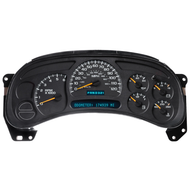
One of the most common failure points for these rides is the instrument cluster. For these modules, it is truly when not if a failure will occur. These failures can show up in a variety of ways. It could show up as one or more of the gauges not reading correctly. Some of the backlighting could be out. Sometimes, the entire cluster will only function intermittently, or not at all. While the cluster failing will not affect the drivability of the truck, it is a safety hazard, as you won’t be able to tell if the truck overheats, how much gas it has, how fast you’re going, etc.
Frequently Asked Questions
-
Why are the gauges sticking or reading incorrectly in my 2003–2006 GM truck? The most common cause is a failed stepper motor behind the gauge. Factory GM clusters from 2003 to 2006 used stepper motors prone to wearing out over time, causing speedometer, fuel, and temperature needles to stick, flutter, or stop working.
-
Is a failing instrument cluster dangerous to drive with? While a broken cluster won't cause the engine to stop running, it is a significant safety hazard. Driving without an accurate speedometer, temperature gauge, or fuel gauge can lead to speeding tickets, unexpected breakdown from running out of gas, or severe engine damage from overheating. While you can still drive with a failing cluster, to keep you and your vehicle safer it's recommended to fix it before something else fails.
-
Can I replace my 2003–2006 Chevy cluster without dealer programming? Yes! Our remanufactured cluster exchange units are pre-programmed 100% plug-and-play. We program your VIN, exact mileage, and engine hours before shipping so you can install it directly without paying a dealer for programming.
-
Why is my odometer or PRNDL (gear indicator) display dim or dark? Dim or flickering digital displays are caused by cracked solder joints and thermal fatigue on the internal circuit board. We correct these failing connections with upgraded components restores full brightness to the screen.
-
Can I add a transmission temperature gauge if my truck didn't come with one? Yes. Full-sized 2003–2006 GM trucks and SUVs (Silverado, Sierra, Tahoe, Yukon, Suburban, Avalanche) already have the factory transmission temperature sensor wired in. Adding a trans temp gauge only requires an upgraded cluster faceplate, stepper motor, and calibration—no extra wiring required.
- Will an LED backlighting upgrade cause hot spots on the dashboard? Standard aftermarket LEDs are directional and can create harsh bright or dark spots. Our specialized LEDs feature a 360-degree light distribution design to ensure smooth, even backlighting across the entire cluster.
Common Repair VS Exchange Questions
-
How long can I drive before returning my core cluster? You have 15 calendar days from the date your exchange unit ships to return your original cluster to avoid a core charge.
-
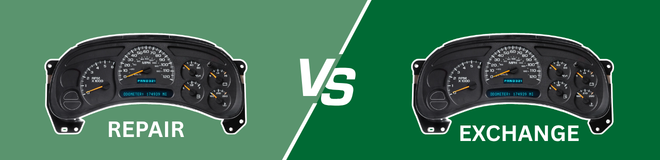
What is the difference between cluster repair and cluster exchange?
-
Repair: You send us your original cluster, we rebuild it, and send it back to you.
-
Exchange: We ship a pre-built, pre-programmed replacement cluster to you first so your truck experiences zero downtime, and you ship your old core back afterward.
-
How to Repair Your Cluster
If your truck is exhibiting some instrument cluster failure symptoms, Circuit Board Medics can help. We can either repair your original instrument cluster or send you a 100% plug and play replacement. Our remanufacturing process on these modules helps to ensure that a repeated failure is highly unlikely, and if one does occur, you are covered by a lifetime warranty.
You’ll also have a couple of options to make the cluster better. We can upgrade the backlighting to LED bulbs with cool blue, dark blue, and green color options, and even add in a transmission temperature gauge if it doesn’t already have one. That’s right, the blank space in the bottom left of your cluster could be populated by a transmission temperature gauge. If you tow or haul, it is highly recommended you have one; if the truck has an automatic transmission of course.
Trucks age, and for a lot of people, “it’s cheaper to keep her” makes good financial sense. If a failed instrument cluster has caused the truck to lose some of its shine in your eyes, let Circuit Board Medics help restore some of that former glory. Give us a call or click one of the links below to see how we can help.
Shop Repair & Exchange Services
Exchanges
- 2003 – 2006 Chevrolet Silverado Exchange Instrument Cluster
- 2003 – 2006 GM, GMC, and Chevrolet Exchange Instrument Cluster
- 2003 – 2006 GMC Sierra Exchange Instrument Cluster
Repairs
- 2003 – 2006 GM Instrument Cluster Repair
- 2003 – 2006 Chevrolet Instrument Cluster Repair
- 2003 – 2006 Chevrolet Avalanche Instrument Cluster Repair
- 2003 – 2006 Chevrolet Tahoe Instrument Cluster Repair
- 2003 – 2006 Chevrolet Suburban Instrument Cluster Repair
- 2003 – 2006 Chevrolet Silverado Instrument Cluster Repair
- 2003 – 2006 GMC Instrument Cluster Repair
- 2003 – 2006 GMC Sierra/Denali Instrument Cluster Repair
- 2003 – 2006 Cadillac Escalade Instrument Cluster Repair